
Spray Foam Insulation in Buford, Georgia
If the house feels calm until the lake air turns damp, the problem is usually bigger than one room. We look at how the building is used, where air is leaking and what the water side of Buford is doing to the structure before we recommend foam. Call 770-294-2013 and tell us which space stops feeling right first.
Free Insulation Estimate
Family ownedOperating since 2010
Spray foam specialistsNot a general insulation reseller
Serving BufordNorth Georgia
Lawrenceville based1891 Prospect Church Road
Buford puts three kinds of buildings close together. There are older houses near the downtown core, newer subdivision homes built fast during growth years, and lake properties that sit in damp air long after a dry inland street has dried out. The same complaint can come from three different causes, so we do not start by naming a product. We start by asking which season makes the house misbehave, which rooms change first and whether the musty smell is coming from below, above or behind a wall.
Lake Lanier changes what a Buford building has to fight.
A house near the water does not get the same break that a house a few streets inland gets. Evening air stays heavy. Boathouses, docks, storage rooms and lower levels can feel cool and clammy even when the thermostat says the number is right. Owners often describe it as a house that never quite dries. That is usually air leakage and boundary placement working together, not a mystery smell and not something a scented treatment solves.
On lake property the weak point is often the place where conditioned space meets a damp, open or semi open area. A crawlspace under a lakeside house can feed air upward. A boathouse room used as a guest space can pull moisture through gaps that were never detailed as living space. Foam helps when the real problem is uncontrolled air and a boundary in the wrong place. It does not make a wet bulkhead dry, and it does not fix drainage that sends water toward the foundation.
A finished lower level is not a crawlspace with carpet.
Sloping lake lots often give Buford houses a daylight basement that is buried on one side and open on the other. That room behaves differently from a crawlspace because people expect it to feel like the rest of the house. If the wall behind the paneling is cold, if the slab edge is exposed to outside air, or if the lower level shares air with a storage bay, the room can feel damp even when the upstairs is calm. We treat the lower level as living space only if the boundary around it is honest.
The rim is where the floor meets the outside.
At the band joist, floor framing, foundation wall and sill all come together in a thin strip that is easy to ignore. In Buford that strip can leak lake air in summer and cold air in winter, especially where plumbing, wires and old vents pass through. Sealing the rim can change a whole floor because it stops a leak at the edge instead of chasing symptoms room by room.
The older downtown core needs a slower look.
Closer to the older part of Buford, houses have often been changed in pieces. A porch became a room. A rear addition went over an old crawlspace. The attic was floored for storage, then ducts were added later. In those houses the thermal boundary can be in more than one place at once, and the owner feels it as a front room that is fine while the back bedroom swings hard. We trace the boundary before we talk about thickness.
Older framing can hide knob and tube wiring, masonry transitions, open chases and repairs from different decades. Foam is useful in many of these assemblies, but preparation matters more. If old material is wet, dirty or hiding a leak, it has to be dealt with before anything new covers it. Covering a problem makes the house quieter for a while and harder to diagnose later.
Large new subdivisions have a different failure pattern.
In newer Buford subdivisions the call is usually not rot or age. It is a bonus room that runs hot, a primary bedroom over the garage, or a two story family room that never settles. These houses can be tight on paper and still uncomfortable because ducts, attic heat and return air are fighting the layout. Foam at the roof deck can be right when equipment and ductwork live in the attic. Foam at the ceiling plane can be right when the attic is empty and meant to stay that way.
A new house does not get a pass because it is new. We still check attic access, bath fan terminations, recessed lights, garage ceilings and the line between conditioned space and attic. If a room is uncomfortable because the duct run is undersized or the return is starving, we say so. Spraying more foam into a house with an air balance problem can make the bill look different without fixing the room.
Garage ceilings and bath fans are small paths with large effects.
A bedroom over a garage often loses at the ceiling before it loses at the walls. The garage door opens, outside air moves, and the floor above feels it. Bath fans matter too. A fan that ends in the attic or dumps into a soffit can feed moist air back toward the rooms it was meant to serve. Those are specific leak paths, and they belong in the inspection before foam is chosen.
Where the boundary belongs in a Buford house.
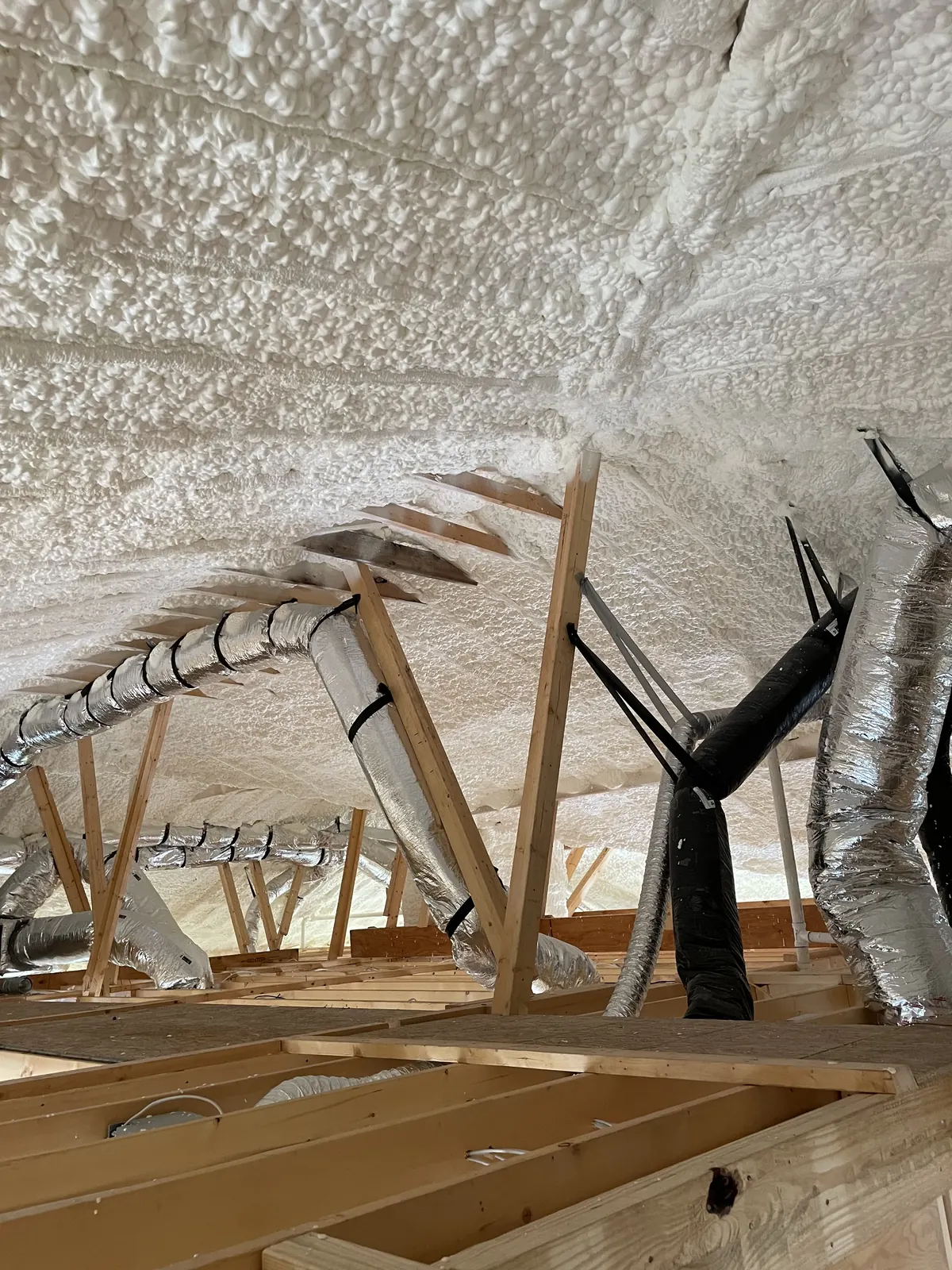
Roof deck foam brings the attic inside the conditioned space. Attic floor foam leaves the attic outside. In Buford the deciding factors are usually ducts, storage, moisture and how the family uses the space. A lake house with equipment above the ceiling points one way. A downtown house with a floored attic full of stored furniture may point another. The building decides, not a habit.
The calendar tells you which symptom to trust.
A Buford owner usually notices different failures at different times. Summer exposes hot bonus rooms, sweating ducts and attic heat pressing down. The first cool mornings show floor drafts and a lower level that will not warm evenly. After long rain, the crawlspace smell and the lakeside storage room tell the truth. Winter wind reveals rim leakage fast. When you call, the season helps us know where to look first, but it does not replace the look.
What has to happen before foam goes in.
We look for active leaks, wet wood, failed bath venting, open soffit paths and any place where outside air is being pulled into the house. If another trade owns part of the problem, that gets named in the scope. The written scope says which surfaces are included, what is excluded, whether removal is needed and what preparation is part of the job.
The written scope lists surfaces, not slogans.
A useful Buford scope reads like a map. It names roof deck or attic floor, walls if they are included, rim areas, crawlspace surfaces if they are part of the work, removal, preparation, ventilation changes owned by others, and the spaces that are staying outside the boundary. If a surface is not listed, it is not implied. That keeps the estimate from growing teeth after the attic is open.
Boathouses and lake accessory spaces are judged as buildings, not extras.
A Buford boathouse or dockside room may be finished, partly finished or used only for storage. Each use changes the answer. If the space is conditioned, it needs a boundary that matches how people use it. If it is not conditioned, sealing random gaps can create a damp box. We ask whether the goal is comfort, protecting stored items, or stopping condensation, because those are not the same job.
An occupied house still has to function during the work.
Most Buford jobs happen while life keeps going. The crew needs clear access to the attic or crawlspace, protection over finished floors, and a plan for pets, alarms and stored items. We tell you which rooms are affected, when the work area should stay empty, and what ventilation is needed before normal use resumes. Reoccupancy is part of the scope conversation, not a surprise at the truck.
A quote has to survive the actual attic and crawlspace.
A Buford quote given from the driveway is a guess. Clearance, access, existing material, roof geometry, moisture and the location of equipment all change the work. We would rather tell you that a smaller scope is the honest fix than sell a larger scope that sounds complete. If the house needs air sealing before foam, or removal before foam, or no foam at all, you hear that before the job is priced.
Start with the room or smell that keeps coming back.
Tell us whether the complaint is a lakeside lower level that feels damp, a downtown house with one stubborn addition, or a subdivision bonus room that gives up every summer. We will look at the parts that decide the scope and give you a written answer you can read before work begins.
Book a free estimate in Buford.
Tell us where the property is, which area is giving you trouble and what you are noticing. We will look at the building before we recommend anything.
- 01We look at the property
The work area, what is already there, the access and anything visibly wrong.
- 02We match the system to the building
Open cell, closed cell, or removal first, based on the assembly and how you use it.
- 03You get a scope you can read
Preparation, surfaces included, removals, exclusions and anything another trade owns.
Spray foam FAQs
Answers to the things Buford property owners usually want settled first.
Do Lake Lanier homes in Buford need a different insulation plan than inland homes?
Often, yes. Lakeside houses deal with damp air for more of the year, and lower levels, boathouses and crawlspaces can feed that moisture into the living space. The plan depends on where the boundary sits and where air is moving, not on the fact that the home is near water alone.
Can spray foam stop the musty smell in a Buford lake house?
It can help when the smell is coming from outside air and damp cavities leaking into conditioned space. It will not fix standing water, failed drainage, wet wood or an active roof leak. We separate those before recommending foam.
Should a Buford attic be foamed at the roof deck or the floor?
If ducts or equipment are in the attic, roof deck foam often makes more sense because the equipment stops sitting in extreme heat. If the attic is empty storage only, the floor can be the better value. Access, moisture and how you use the space settle it.
Do you insulate boathouses or dockside rooms in Buford?
When the space is used like a building, we treat it like a building. The first question is whether it is conditioned and what the goal is. Foam can be wrong in an open damp structure and right in a finished room, so we look before answering.
What moves the cost on a Buford insulation job?
Square footage matters, but so do roof deck versus floor work, foam thickness, access, removal, preparation and whether ducts, vents or old material change the assembly. We do not give a vague rate. The free estimate turns into a written scope.
Start with the part of the property that needs attention.
Each guide covers what we inspect, how the material gets chosen and the questions worth asking any contractor.
Get a spray foam estimate in Buford.
Family owned, straight answers, and we will tell you if foam is the wrong call for your building.