
Spray Foam Insulation in Johns Creek, GA
The most common insulation call in Johns Creek is the room over the garage that nobody can use in August. It is a real problem in this housing stock, and it is worth understanding before anyone sells you anything.
Free Insulation Estimate
Family ownedOperating since 2010
Spray foam specialistsNot a general insulation reseller
Serving Johns CreekNorth Georgia
Lawrenceville based1891 Prospect Church Road
Johns Creek is full of two-story houses built from the 1990s through the 2010s, and an enormous share of them have the same floor plan feature: a bonus room sitting on top of the garage. It is the playroom, the office, the teenager's room, the guest suite. And in a Georgia summer it is often the one room in the house that the air conditioning cannot reach. Owners describe it the same way every time. The rest of the house is fine. That room is ten degrees behind, and by midafternoon it is simply unused space that you are paying to cool.
The bonus room over the garage is the call we get most in Johns Creek.
The room sits in the worst spot a room can sit. Below it is a garage that heats up like a parked car. Beside it, on at least one wall, is attic space. Above part of it is often attic floor. It is surrounded by unconditioned space on more faces than any other room in the house, and the surfaces separating it from that space were typically given the least attention when the house was built. Kneewalls with gaps at the floor line. A garage ceiling with voids around every duct and wire that crosses it. Dormers that were sealed poorly at the cheeks. When we insulate these rooms properly, at the roofline and the garage ceiling, with the kneewalls and slopes treated as part of the same continuous boundary, the change is usually obvious the first hot afternoon. Often yes, foam fixes the bonus room. It is one of the most satisfying jobs we do.
Kneewalls and slopes fail at the joints, not in the middle.
The flat middle of a kneewall is rarely the problem. The failures live where the parts meet: the bottom of the kneewall where it lands on the floor, the top where it meets the sloped ceiling, and the ends of the slopes where they die into the attic floor. Each joint is a gap straight into unconditioned space, and behind most kneewalls is a floor cavity open to the level below, so the room bleeds air downward as well as sideways. Treating these rooms properly means spraying the roofline above the slopes and sealing each joint into one continuous piece, so the kneewall stops being a door left open to the attic. That is why the patch approach, one surface at a time, so often disappoints in these rooms.
Sometimes the attic is not the real problem.
Here is the part that costs you nothing and saves some homeowners a wasted job. A bonus room can also be fighting duct sizing or a return-air problem, and foam will not fix either of those. These rooms sit at the end of the longest duct run in the house, fed by equipment that was sized for the original floor plan. If the supply is undersized, the room starves. If there is no return path, the room pressurizes when the door closes and the supply air slows to a trickle. You can wrap that room perfectly and it will still lag, because the problem was never the shell. When we look at a bonus room, we look at the airflow too, and if we think your real problem is mechanical, we will say so and point you at the right trade first.
How we tell an attic problem from a duct problem.
A few simple observations separate the two. Feel the airflow at the bonus room supply register and compare it to a bedroom that behaves; weak flow there points at the duct run, not the shell. Close the bonus room door for an hour with the system running, then open it and feel for a pressure push; that points at a missing return path. Then note when the room is worst. A room that falls behind on sunny afternoons and catches up overnight is losing a fight with a hot attic. A room that is weak in every weather, morning and night, is usually starving for air. We run through this in the attic and at the registers before we quote, because the wrong diagnosis wastes your money in either direction.
This matters across Johns Creek because the houses are so consistent. Same era, same construction culture, same details repeated subdivision after subdivision. Once you have diagnosed a few hundred of these floor plans, the patterns are familiar, and so are the exceptions. We would rather talk you out of a job that will not work than install one that will not perform.
When the air handler lives in the attic, the boundary belongs at the roof deck.
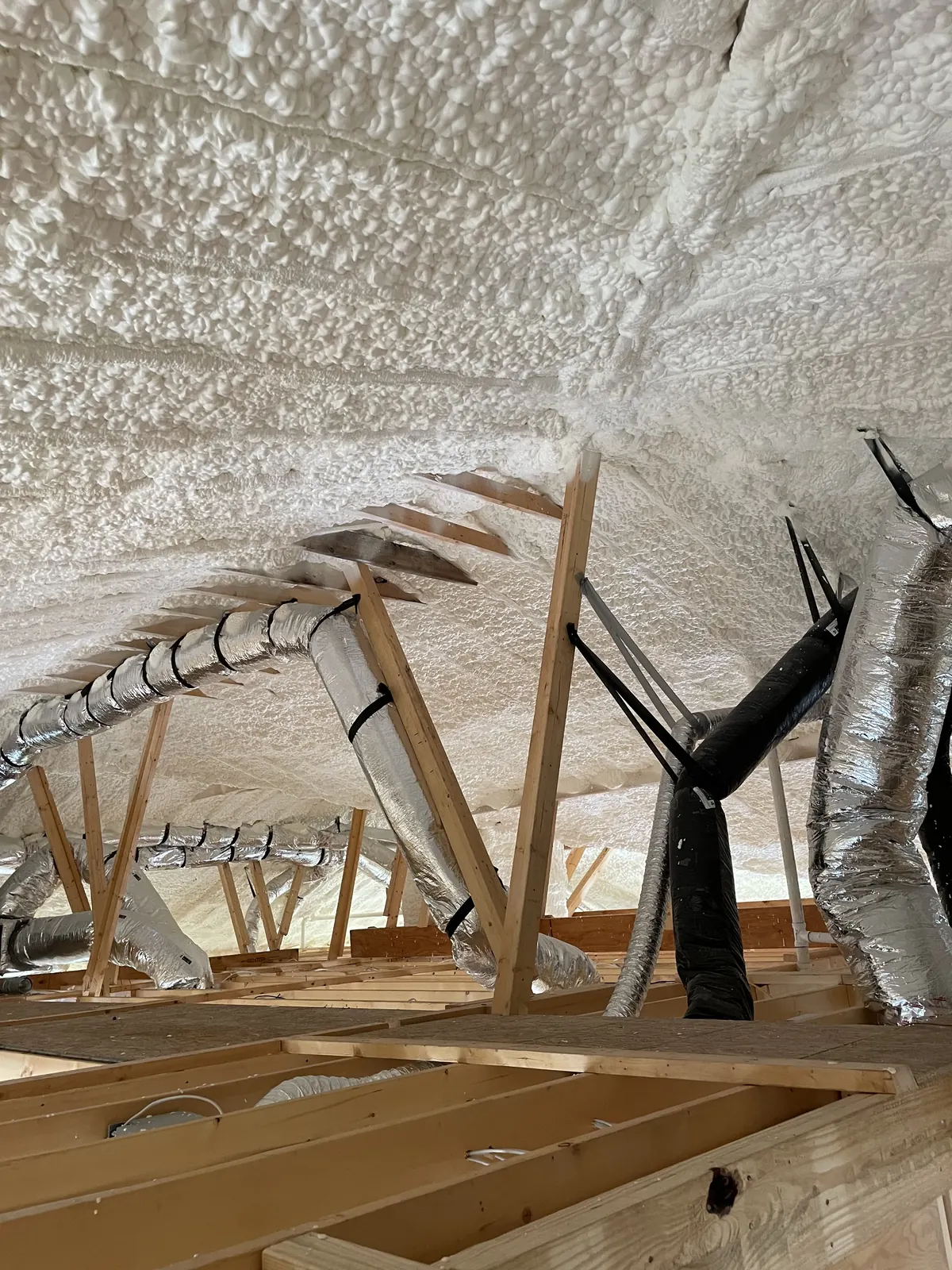
The other defining feature of these houses is where the mechanical equipment sits. In most Johns Creek two-stories, the air handler for the upstairs, and often the whole house, lives in the attic, along with every duct that feeds the second floor. That attic is vented, which means all summer long the equipment that makes your cold air is sitting in the hottest space on the property, and every duct run is losing conditioned air into it through joints and seams. Insulating at the roof deck brings the attic inside the conditioned space. The air handler stops baking. The ducts stop leaking into an oven and start leaking into space you are already cooling, which is a very different thing. For this housing stock, it is usually the single largest change we can make to how the second floor behaves.
Sweating ductwork is a different complaint than a hot room.
Some Johns Creek calls are about water, not temperature. A stain near a ceiling register. A drip at a vent. A duct dripping onto stored boxes. In a humid vented attic, cold duct surfaces condense moisture out of the air the same way a cold drink sweats in July, and owners often assume a roof leak. Roofers get called for what is actually an attic humidity problem. Bringing the attic inside the conditioned boundary at the roof deck dries the air the ducts sit in, and the sweating stops with it. If the ducts themselves leak badly, sealing them is part of the same conversation, because a leaky return is part of what pulls humid air across the cold metal in the first place.
It is also a decision with consequences, and we treat it that way. Moving the boundary to the roof deck changes how the roof assembly handles air and moisture. Soffit vents, ridge vents, bath fan terminations and equipment access all get reviewed as part of the same decision, not discovered halfway through the job. Done correctly it is a well-understood assembly. Done casually it creates problems, which is why the look in the attic comes before any quote.
What changes inside a Johns Creek attic.
The ducts stop sitting in an oven.
Once the attic is inside the boundary, the ductwork runs through space that stays near the temperature of the house. The air that leaves the air handler is much closer to the air that arrives at the register, and the equipment stops running extra time to make up the difference.
The bonus room stops being surrounded by heat.
The kneewalls, slopes and garage ceiling get treated as one continuous boundary instead of a patchwork. The room over the garage becomes just another room, which is all it ever should have been.
The written scope lists the job surface by surface.
A Johns Creek scope does not say attic, it says which attic. The roof deck, the named slopes and kneewalls, the garage ceiling where it applies, each surface listed on its own line with the preparation that goes with it. Removal of old material is named if it is needed. Ventilation changes at the soffits and ridge are named if the boundary is moving. The exclusions are listed just as plainly, and so are the expected duration and the window you need to be out of the work area. If a line is not on the scope, it is not in the price, and we would rather have that conversation at the estimate than at the invoice.
What we mean when the scope says another trade owns it.
Some things in an attic belong to other licenses, and we do not bury them or work around them quietly. Gas flues need their clearances kept, and a furnace or water heater venting through the attic is a mechanical contractor's call before it is an insulation job. Recessed lights get checked for contact ratings before anything covers them. Bath fan ducting through the roof is roofing or mechanical work. Wiring that looks questionable gets flagged for an electrician, not foamed over. When the scope names an exclusion, it is telling you who to call before we start, and a house that needs that call is better off making it.
Tell us which room you cannot use.
Start with the complaint. The bonus room, the hot upstairs, the master bedroom over the garage. We will get in the attic, look at the equipment and the duct runs, and tell you honestly whether foam is your answer or whether something mechanical should be looked at first. Call 770-294-2013. The estimate is free and the scope is written.
Book a free estimate in Johns Creek.
Tell us where the property is, which area is giving you trouble and what you are noticing. We will look at the building before we recommend anything.
- 01We look at the property
The work area, what is already there, the access and anything visibly wrong.
- 02We match the system to the building
Open cell, closed cell, or removal first, based on the assembly and how you use it.
- 03You get a scope you can read
Preparation, surfaces included, removals, exclusions and anything another trade owns.
Spray foam FAQs
Answers to the things Johns Creek property owners usually want settled first.
Will spray foam fix the bonus room over my garage?
Often yes, and it is one of the most common reasons Johns Creek owners call us. The room is surrounded by unconditioned space on more faces than any other room in the house. But a bonus room can also be fighting duct sizing or a return-air problem, and foam will not fix either of those. If we think the attic is not your real problem, we will say so.
Why is my upstairs so warm when the house is not that old?
Because of where the equipment lives. In most Johns Creek two-stories the air handler and the ductwork sit in a vented attic, so the system that cools the upstairs runs all summer in the hottest space on the property. Bringing the attic inside the conditioned space at the roof deck usually changes how the whole second floor behaves.
Does having the air handler in the attic change what you recommend?
Yes. When the equipment and ductwork are up there, insulating at the roof deck usually makes more sense than insulating at the attic floor, because the ducts stop losing conditioned air into a vented oven. An empty attic that stays empty can be a different answer. We settle it in the attic, not on the phone.
The bonus room already has a supply vent. Why is it still uncomfortable?
A supply without an adequate return path pressurizes the room when the door closes, and the airflow slows down. Long duct runs to equipment sized for the original floor plan make it worse. Foam fixes the shell, and the shell is often a real part of it, but airflow problems need a mechanical answer, and we will tell you which one you have.
Can you insulate just the garage ceiling under the bonus room?
A partial boundary rarely performs the way owners hope. The room is exposed on several faces, and treating one surface while leaving the kneewalls and slopes open leaves gaps the heat will find. We look at the whole assembly around the room and quote what will actually work, not what is cheapest to spray.
What does spray foam insulation cost in Johns Creek?
It moves with the surfaces involved, roof deck or attic floor or bonus room assembly, which foam the job calls for, the thickness required, the access, and whether anything has to be removed first. We do not publish a rate per square foot because a number that vague is not useful. The estimate is free and specific to your house.
Start with the part of the property that needs attention.
Each guide covers what we inspect, how the material gets chosen and the questions worth asking any contractor.
Get a spray foam estimate in Johns Creek.
Family owned, straight answers, and we will tell you if foam is the wrong call for your building.