
Crawl Space Encapsulation for Athens Homes and Rentals
If your Athens rental keeps producing the same musty smell complaint, or the floors in your older home feel cold and damp every spring, the crawl space under the house is the place to look. Most owners have never been under there. We have.
Free Insulation Estimate
Family ownedOperating since 2010
Spray foam specialistsNot a general insulation reseller
Serving AthensNorth Georgia
Lawrenceville based1891 Prospect Church Road
A tenant complaint is usually how an Athens crawl space gets discovered.
A renter calls the property manager about a smell that will not leave the front room. Or the floors feel cold and faintly soft by spring. Or the roaches keep coming back no matter how many times someone sprays. In a university town with a large stock of older rental houses, this is how a crawl space usually announces itself. Not through the owner, who may live across the state and has never been under the house, but through the person living above it, who has no authority to fix anything and no idea what is under their feet.
Athens holds two kinds of older housing side by side. There are owner-occupied historic homes, maintained in careful layers by families who plan to stay. And there are rental houses near the center of town, kept running on a maintenance budget by owners who see them as investments first. A great many of both sit on raised, vented crawl spaces, because that is how houses here were built for generations. The two kinds of owners need different conversations, but the dirt underneath them behaves exactly the same.
The red clay under an Athens house does not let water leave.
The soil in this part of Georgia is red clay, and red clay does not drain the way people wish it did. Water that falls on the lot soaks in slowly, moves slowly, and collects wherever the ground is lowest, which under an older house is often the crawl space itself. Once water is in clay, it stays. The ground under a vented house here can hold moisture for weeks after the yard looks dry, and all of that moisture sits in constant contact with the underside of the home.
The vents were supposed to solve this. The theory was that air moving through the crawl space would carry moisture away, the way a breeze dries laundry. In a Georgia summer the opposite happens. The air outside is loaded with humidity, and when that air slides into the cool shade under a house, it gives up its water on every surface it finds. Floor joists, duct trunk lines, plumbing, the facing on old material. The vents do not dry the space. They feed it.
Water gets under an Athens house in ordinary ways.
Some of it is plumbing, a slow drip from a supply line or a condensate drain that ends under the house instead of outside it. Some of it is the lot itself, soil that has settled over the decades until the grade points back toward the foundation, or downspouts that dump roof water right beside the wall. None of these are dramatic. All of them are common on older Athens lots, and all of them feed the same damp space. Finding them is part of the inspection, because sealing a crawl space while a downspout still floods it is money spent to bury a problem.
Rental property changes who says yes and what gets done.
In an owner-occupied house, the person who smells the problem is the person who can approve the fix. In a rental, those are two different people, and the distance between them is where crawl space problems grow old. The tenant reports a symptom. The landlord weighs an expense against a house they do not live in. The repair gets deferred, then deferred again, and the moisture under the house keeps its own schedule. By the time a recurring complaint finally triggers a real look underneath, the job is usually bigger than it would have been the first year anyone mentioned it.
We work with landlords and property managers regularly, and the process is built for it. The inspection produces photographs and a written scope, so an owner who has never seen the underside of their own house can still make an informed decision. The scope separates what must happen now from what can honestly wait, because not everything under a house is urgent, and pretending otherwise is how trust gets lost.
There is a version of crawl space work that is reasonable to defer and a version that is not. Standing water, fungal growth on the joists and wet material hanging from the floor framing are not cosmetic issues. They are active damage, and they get worse on their own timetable. A landlord who wants to phase a project can usually phase the finishing touches. The water and the growth cannot be phased.
What encapsulation actually means under a house.
The ground gets sealed first.
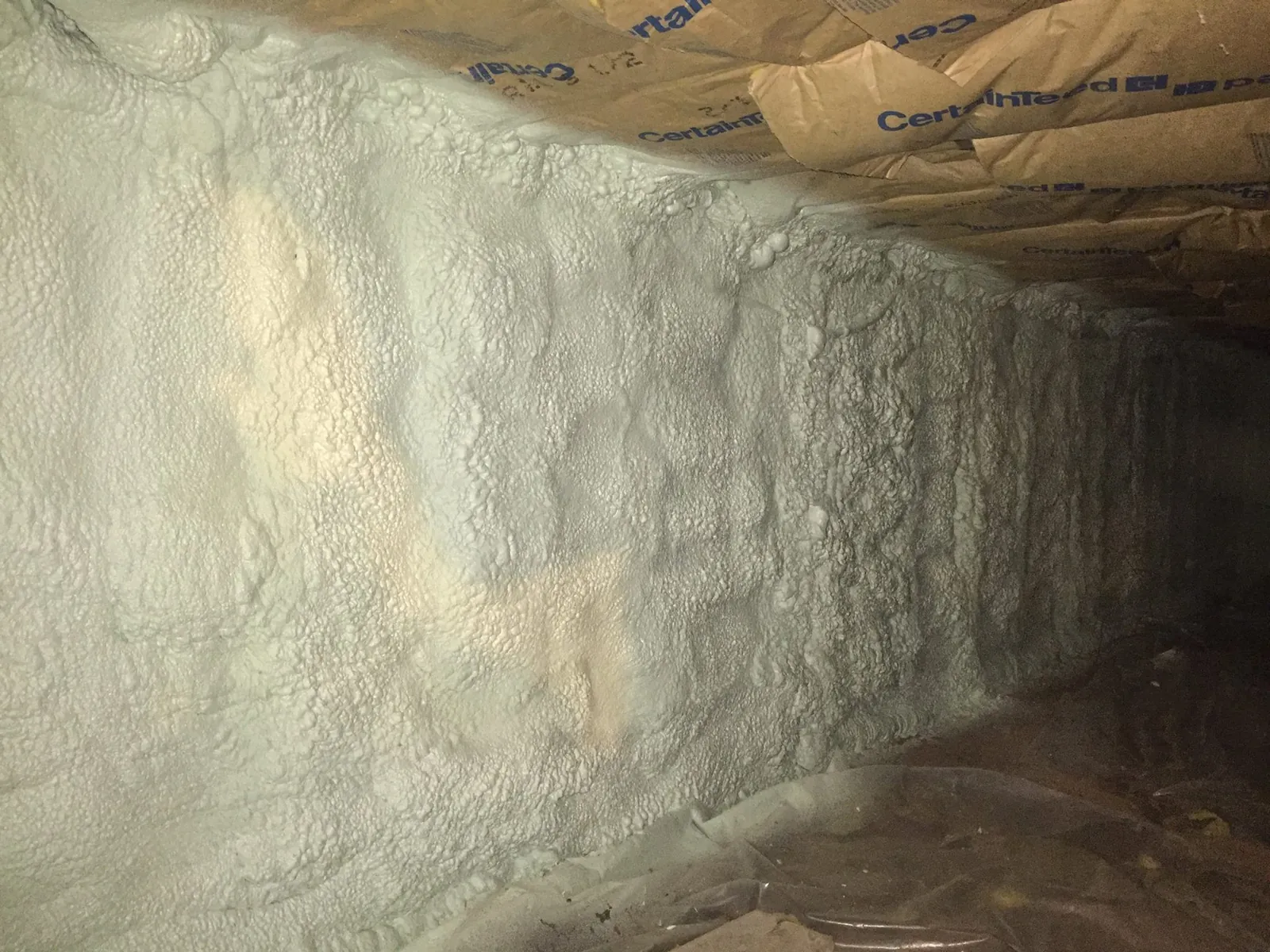
A heavy liner goes down across the entire floor of the crawl space, runs up the piers and the foundation walls, and gets sealed at every seam and edge. The goal is simple. The moisture in the ground stays in the ground, and the house above it stops drinking from the soil. Where the liner goes and how it is fastened matters more than the material itself, because a gap at a pier is a door left open.
The vents and gaps get closed.
Once the ground is sealed, the space stops breathing outdoor air. Vents get closed and sealed, gaps at the rim and the access door get tightened, and the crawl space is cut off from the weather it used to invite in. This is the step that reverses the old theory. The space is no longer trying to dry itself with humid air. It is no longer trying to dry at all. It is being kept dry.
The air gets managed afterward.
A sealed crawl space still needs its air handled, either with a dehumidifier sized for the space or with a measured supply of conditioned air from the house. Which one is right depends on the house, the budget and how the rest of the system is set up. We settle that during the inspection, and it is part of the written scope, not a surprise on the day.
What a scope from us answers before anyone books.
- What is being sealed, and with what, across the floor, the piers and the walls.
- What happens to any standing water or drainage problem before the liner goes down.
- What comes out first, including wet material hanging from the floor joists and debris left by earlier work.
- How the air will be managed once the space is sealed, and who owns the electrical if a circuit is needed.
Historic homes hear a different version of this talk.
For the owner of an older Athens home who plans to stay, the conversation is less about complaints and more about the house itself. Hardwood floors that cup a little more each summer. A pier that has started to lean. Framing that has stayed damp long enough to soften. These houses have stood for a century or close to it, and most of what threatens them now comes up from below. Encapsulation is, in a real sense, a preservation decision. It stabilizes the environment the whole structure rests on, and it does it without touching anything the family loves about the house.
Owners who encapsulate usually describe the change in plain terms. The smell they had stopped noticing is gone. The floors stay flatter through the summer. The house heats more evenly in winter, and the air inside stops feeling heavy. Underneath, the structure finally gets to dry out and stay that way, which is the entire point for a house meant to stand another hundred years.
Whether the property is a rental near the center of town with its third manager in a decade or a family home that has stayed in the same hands for generations, the physics under it are identical. The clay holds water, the vents invite humidity, and the house above absorbs the cost. What changes is who we are helping and how the decision gets made. We are set up for both.
What the work costs depends on what is under the house.
Encapsulation pricing moves with the square footage of the footprint, the clearance height, because a crawl space you can kneel in is a different job than one you can nearly stand in, whether water has to be managed before sealing, how much old material has to come out, and how the air will be handled afterward. Rental houses sometimes carry surprises from years of deferred maintenance, and we price what is actually there, not what was hoped. The estimate is free and the scope is written, so an owner can approve it from anywhere.
Tell us what the tenant said, or what you have been smelling.
Send the estimate form with whatever you know, even if all you know is a complaint that keeps coming back. We will get under the house, photograph what we find, and put a scope in front of whoever signs. Green Earth is family owned, we have been doing this since 2010, and we stand behind the work.
Book a free estimate in Athens.
Tell us where the property is, which area is giving you trouble and what you are noticing. We will look at the building before we recommend anything.
- 01We look at the property
The work area, what is already there, the access and anything visibly wrong.
- 02We match the system to the building
Open cell, closed cell, or removal first, based on the assembly and how you use it.
- 03You get a scope you can read
Preparation, surfaces included, removals, exclusions and anything another trade owns.
Start with the part of the property that needs attention.
Each guide covers what we inspect, how the material gets chosen and the questions worth asking any contractor.
Get a spray foam estimate in Athens.
Family owned, straight answers, and we will tell you if foam is the wrong call for your building.